


Abstract: As to the problem about whether the Description is clear and complete or not, the judgement standard should be whether it can be understood by a person skilled in the field and can be realized, rather than whether there are ambiguities and errors or not and even the amount of ambiguities and errors in the Description. If those skilled in the field can understand the related technical meanings of the unclear description by referring to the other parts of the Description and attached drawings, can find the errors in the Description, and can carry out the invention on the basics of their understanding and correction, it can be considered that the Description of the invention is clear and complete.
According to the provisions of Article 26.3 of the Chinese Patent Law: the description shall set forth the invention or utility model in a manner sufficiently clear and complete so as to enable a person skilled in the relevant field of technology to carry it out;where necessary, drawings are required. The abstract shall state briefly the main technical points of the invention or utility model.
Although there is this legal basis for judgement about the clarity and completeness of the Description, the judgment is often affected by subjective factors in practice. It is always a sensitive and hot issue to know whether the description is clear and complete, or how do unclear description and errors affect the clarity and completeness of the description?
Hereinafter, the author’s thoughts and considerations on whether the description is clear and complete would be addressed detailedly with typical cases.
1. Introduction of the Case
The patent involved is an invention patent 97123475.2 entitled “rotary dobby and weaving loom provided with such dobby” which is granted by the National Intellectual Property Administration of PRC(hereinafter referred to as “CNIPA”) on October 11 in 2000, with the application date of December 30 in 1997 and the priority date of December 31 in 1996.The patentee of the invention patent is Staubli Faverges, Faverges, France.
In response to the above patent, ChangShu Texible Company has filed a request of declaring the patent right invalid with the Patent Reexamination Board of CNIPA(hereinafter referred to as “PRB”), based on the invalidation reasons that the Description does not comply with the provisions of Article 26.3 of the Patent Law and claims 1-5 does not comply with the provisions of Article 26.4 of the Patent Law respectively.
PRB made a decision after examination to maintain the validity of the patent involved. ChangShu Texible Company refused to accept the invalidation decision and filed an administrative lawsuit with the Beijing NO.1 Intermediate People’s Court. The Beijing NO.1 Intermediate People’s Court held the decision of the PRB in the first instance. ChangShu Texible Company refused to accept the first-instance judgment and appealed to the Beijing Higher People’s Court. The second instance of the Beijing Higher People’s Court annulled the judgment of the Beijing NO.1 Intermediate People’s Court and sentenced the PRB to review the request for invalidation of the patent involved again. The patentee of Staubli Faverges, Faverges, France refused to accept the second-instance judgment and applied retrial to the Supreme People’s Court of the People’s Court.
The Supreme People’s Court of the People’s Republic of China set up a collegial panel. The collegial panelthe Supreme People’s Court held that in this case, ChangShu Textile Company listed the (a) to (e) five points that are unclear in the Description of patent involved, and accordingly claimed that the Description of patent involved does not clearly and completely explain the technical content of the invention, so that a person skilled in the field of technology can not to carry it out, which does not comply with the provisions of Article 26.3 of the Patent Law. In addition, ChangShu Textile Company believes that claims 1-5 in the patent involved do not comply with the provisions of Article 26.3 of the Patent Law, because a person skilled cannot obtain or generalize the technical solution by the claims of patent involved from the contents disclosed in the Description . In this regard, the collegial panel of the Supreme People’s Court conduct comprehensive analysis one by one:
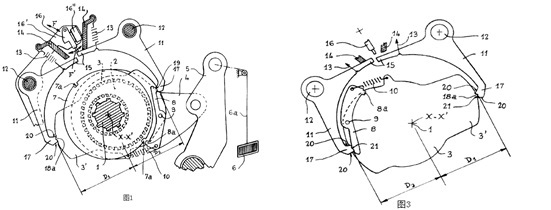
Regarding (a), in line 7 of page 5 of the Description of patent involved, it is described that “A spring 10 continuously releases the pawl 8a from the catch 8 towards the shaft 1”. ChangShu Textile Company believed that the person skilled cannot understand the meaning of “release”.
According to the analysis of the collegial panel, although the word of "release" is unclear, a person skilled in the field can get a clear and complete understanding of the technical solution according to the contents of the description and the FIG.1 of the patent involved.
Regarding (b), in lines 14-15 of page 5 of the Description of patent involved, it is described that “The tappet 16 is mounted on a pivot member 16' driven by a back and forth motion by pivoting around the stationary spindle 12 of one the arms 11”. ChangShu Textile Company considered that the above description and the following description of the mechanism transmission mode that “when an arm 11 is controlled by the tappet 16 against the corresponding spring 13” “if the actuator 16 transmits an effective force of the tappet to the drive rod 15 of the arm 11 represented at the right” are contradictory.
The collegial panel considered that lines 14-15 of page 5 of the Description of patent involved records “The tappet 16 is mounted on a pivot member 16’ driven by a back and forth motion by pivoting around the stationary spindle 12 of one the arms 11”,and thereafter it is stated that “by way of example, activated by a not represented cam mechanism”, combined with FIG.1, it can be seen that "the arm 11" in the above technical content does not refer to the twisted arm 11, but to the arm that is integrated with the pivot member 16' installed on the spindle 12. Here, "11" of "the arms 11" is an obvious marking error. Moreover, those skilled in the field have already obtained a certain understanding of the position and structure of the arm 11 by reading the contents in the lines 9-12 of page 5 of the Description of patent involved, and can further know the position and their mutual relationship between the pivot member 16' and the arm 11 by frtther reading the paragraph 3 of page 6 of the Description, and combined with the FIG.1,. Therefore, although there is a marking error in the Description of patent involved, those skilled in this field can clearly recognize the error and correct it by reading the context of the Description with reference to the attached drawings.
Regarding (c), in lines 4-7 of page 6 of the Description of patent involved, it is described that “when is in the absence of an actuation of the tappet of the reading-in device, at the moment when each stop of the plate 1 is facing the catches 17, the springs 13 cause these catches to interact with the notch-shaped binding surface 19, which has the concomitant effect to angularly immobilize the plate 3, and with it the eccentric gear 2 and the connecting rod 4”. ChangShu Textile Company considered that “when is in the absence of an actuation of the tappet of the reading-in device” is an ambiguous statement. Those skilled in the field cannot understand the above description of the technical solution, and the loom of the patent involved cannot operate the heddle frame "when is in the absence of an actuation ".
According to the analysis of the collegial panel, although "when is in the absence of an actuation " is unclear, a person skilled in the field can clearly understand the technical meaning of "when is in the absence of an actuation ", which means " there is no effect of actuation", based on the Description and attached drawings of the patent involved.
Regarding (d), in lines 10-13 of page 7 of the description of patent involved, it is described that “if it is not necessary to disengage the catch 17 of the arm 11, located at the right in FIG.3, from the notch 19, the tappet 16 is oriented by the control element 16’’ towards the arm 11, located at the left in FIG.3. Since it is out of reach of the tappet 16, no impact takes place between this tappet 16 and the arm 11, located at the left in FIG.3, so that no noise is generated”. ChangShu Textile Company considered that the technical content shown in FIG.3 is significantly different from the above description, and the above contradictory description makes it impossible for a person skilled in the field to understand the present invention.
The collegial panel considered that in page 7 of the Description of patent involved, paragraph 2 has the words of "in the position of FIG.1...", paragraph 5 has the words of "in FIG.3...”, and according to the common Chinese grammar , paragraphs 2, 3 and 4 are to interpretFIG.1; in view of the specific content, since the content described in paragraphs 2 and 3 of page 7 is the functioning principle of the tappet 16 when the catch 17 are disengaged or engaged with the notch 19, the description of the two paragraphs is obviously an explanation of the technical content shown in FIG.1; in addition, the difference between FIG.1 and FIG.3 is just that plates rotated 180°, the arm 11 has the same location in FIG.3 and FIG.1, Therefore, those skilled in the field will not consider the two paragraphs are directed to FIG.3 just because " the left or right in FIG. 3" are used to describe the arm. Therefore, although there is a marking error in the Description of patent involved, those skilled in this field can clearly recognize the error and understand the invention by reading the context of the Description and combining with the attached drawings.
Regarding (e), in the line 6 from the bottom of page 7 to the line 1 of page 8 of the description of patent involved, it is described that “in FIG.3, the plate 3 is shown after a 180° rotation with respect to its position in FIG.1, in this position, the arm 11, located at the right in FIG.3, is driven out by pivoting around its spindle 12 in the counter-clockwise direction, so that it is out of reach of the tappet 16. As above, if it is not necessary to act upon the arm 11, located at the right in FIG.3, and can be driven by the flange 16’ on which it is mounted, without this motion causing a contact between the actuator 16 and one of the arms 11”. ChangShu Textile Company considered that those skilled in the field cannot understand the contents of the above technical solutions.
According to the analysis of the collegial panel, the technical meaning described in the above technical solutions can be clearly understood by those skilled in the art according to the record of the description and FIG.3.
In summary, the collegial panel believes that the description of patent involved has clearly and completely explained the technical content of the invention, on this basis, those skilled in the field can also get the technical solution claimed in the patent claims from the contents disclosed in the description of patent involved Therefore, claims 1-5 comply with the provisions of Article 26.4 of the Patent Law. And the patent involved comply with the provisions of Article 26.3、26.4 of the Patent Law. The Supreme People’s Court of the People’s Republic of China annulled the administrative judgment of the Beijing Higher People’s Court and maintained the administrative judgment of the Beijing NO.1 Intermediate People’s Court.
2. Case Comments
Hereinafter, as to the (a) to (e) unclear points in the description listed by ChangShu Textile Company the author provides summary and classified comments by combining with the judgment of the Supreme People’s Court.
(a), (c), and (e) points are issues that some descriptions are unclear. Among them, as to (a), there are unclear words in the Description, that is, the unclear word of "release" is used; as to (c), there are unclear descriptions in the Description, that is, clear description of " when is in the absence of an actuation" is unsed; as to (e), there are unclear descriptions in the Description. In accordance with the judgment of the Supreme People’s Court, although the Description uses words or descriptions that are unclear, those skilled in the field can understand the true meaning of the unclear words or descriptions by the other parts of the Description and with reference to the attached drawings. Thereby the technical solution can be understood clearly and completely, and it is considered that the unclear words or descriptions do not affect the clarity and completeness of the Description.
(b) and (d) points are issues that there are mistakes. Among them, as to (b), there is marking error in the Description, that is, the reference number 11 of "the arm 11" are the same as that of a different arm described in the following text. Regarding (d), the attached drawings were incorrectly referred to in the Description, that is, FIG.1 is wrongly referred to as FIG.3. Although the errors in the Description are literally unclear or even cause contradictory problems, those skilled in the field can discover by themselves and correct the errors by referring to the other parts of the Description and attached drawings, and understand the technology, and admit that the errors do not affect the clarity and completeness of the Description.
In conclusion, as to the problem about whether the Description is clear and complete or not, the judgement standard should be whether it can be understood by a person skilled in the field and can be realized rather than whether there are ambiguities and errors or even the amount of ambiguities and errors in the Description. If those skilled in the field can understand the related technical meanings of the unclear description by referring to the other parts of the Description and attached drawings, can find the errors in the Description, and can carry out the invention on the basics of their understanding and correction, it can be considered that the Description of the invention is clear and complete.
3. Extension Comments
Although the Description of the patent was finally determined to be a clear and complete in this case, the difference in the judgment results of different level courts in administrative proceedings after the invalidation was really a wake-up call to us.
In practice, for various reasons, the Description often has ambiguities or errors. Although whether there are ambiguities and errors or not and the amount of ambiguities and errors in the Description should not be deemd as a judgment standard of the clarity and completeness of the Description this does not mean that we can leave the ambiguities or errors in the Description. After all, ambiguity or error will most likely result in the Description being determined to be unclear and incomplete, making it difficult to obtain a patent or even invalidating the patent obtained. Therefore, in practice, we should make efforts to avoid ambiguity or errors in the Description.