


Abstract: For assessing the inventiveness, the technical solution of claims shall be taken into consideration as a whole, rather than individual technical features. The “whole” perspective means that we shall consider not only the technical solution itself, but also the technical field, the technical problem to be solved and the technical effect, without individualizing the technical features.
The inventiveness assessment of an invention is a crucial part which dramatically affects granting or non-granting patent in the substantive examination procedure and even validation or invalidation of the patent. In practice, the concerned parties would draw a totally different conclusion on inventiveness assessment, not only due to the different standpoints of the concerned parties, but also the inherent subjectivity of inventiveness assessment. Hence, it is often discussed about how to make a more objective and justicial assessment of inventiveness. In this article, it is suggested that more attention should be paid to “whole” perspective, which is also a difficult and even blind point in practice.
Hereinafter, the author's thoughts and considerations on “whole” perspective of inventiveness assessment would be addressed with a real invalidation case.
1. Overview of Guidelines
Some important principles and methods of inventiveness assessment are set forth in Chapter 4, Part II of Guidelines for Patent Examination(2010). Among them, the provisions reflecting the “whole” perspective are as follows:
a) as specified in section 3.1 on "principle of examination", “when evaluating whether or not an invention involves an inventive step, the examiner shall consider not only the technical solution itself, but also the technical field to which the invention pertains, the technical problem solved, and the technical effects produced by the invention. The invention shall be considered as a whole”.
b) as specified in section 3.2.1.1 about "whether or not the claimed invention is obvious", "the examiner shall make a judgment, starting from the closest prior art and the technical problem actually solved by the invention, as to whether or not the claimed invention is obvious to a person skilled in the art. In the course of judgment, what is to be determined is whether or not there exists such a technical motivation in the whole of the prior art".
c) as specified in section 6.4: the evaluation of inventive step shall be directed to the whole of each technical solution defined in the claims, that is, it is the technical solution as a whole, rather than the individual technical features, that shall be evaluated as to whether involving an inventive step.
In the author's opinion, items a and b are actually to emphasize that the technical problems as the source of inventiveness judgment shall not be ignored. Secondly, item c is actually to emphasize that the correlation between technical features shall not be ignored. The author's analysis would be illustrated hereinafter with reference to a specific invalidation case document.
2. Basic Information of the Case
Invalidation Decision No.: 34351
Party Requesting Invalidation: Jingsong Li
Patentee: Chong electric industrial Co., Ltd
Patent No.: ZL201180021569.0
Title of the Invention: Banknote Teller Machine
Application Date: October 14, 2011
Priority Date: November 10, 2010
Authorized Announcement Date: May 07, 2014
Invalidation Decision: maintain the patent right of the invention
Claim 1 of the patent involved:
A banknote teller machine, including: device frame (5); drawer (6) with storage boxes therein; and slide rails (7a and 7b), for loading and unloading the storage box (4) by pulling the drawer (6) out of the device frame (5) in a pull-out direction (A), which contain two slide rails (7a and 7b) in two different heights, wherein the slide rail (7a) on the loading and unloading side (B) of operating the storage box (4) is configured to be lower than the other slide rail (7b).
One of the important invalidation evidences:
Korean patent: KR10-2007-0028058 A (hereinafter referred to as " D1")
D1 discloses a financial automatic banknote machine with two different slide rails on two sides.
3. Dispute Focus
The distinguishing technical feature between patent involved claim 1 of the involved patent and D1: the slide rail (7a) on the loading and unloading side (B) of operating the storage box (4) is configured to be lower than the other slide rail (7b).
Focus 1: What kind of technical solution does claim 1 of the involved patent protect as a whole? Does the above distinguishing technical feature include limitation on the mode of loading and unloading? And, is it different from the technical solution in D1?
Focus 2: Is there any teaching in D1 for obtaining claim 1 of the involved patent by adopting the above distinguishing technical features?
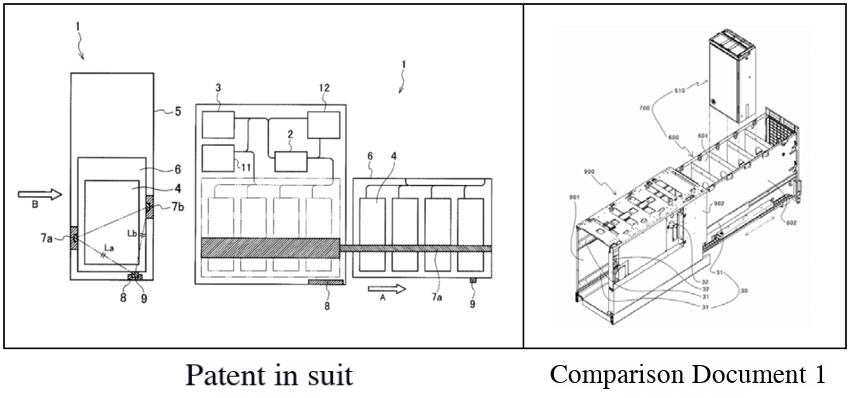
4. Summary of Invalidation Decision
The panel of Patent Reexamination Board (referred as “PRB panel”) asserts that the distinguishing technical features of claim 1 are that the slide rail (7a) on the loading and unloading side (B) of operating the storage box (4) is configured to be lower than the other slide rail (7b). By comparing claim 1 with the whole technical solution of D1, it can be known that in claim 1, the storage box is loaded and unloaded from one side of the drawer(i.e. loading and unloading side) , and the height of the side plate at the side of loading and unloading the drawer is not necessary to be as high as that of the opposite side plate, so that users do not have to raise their hands to load and unload the box from the top of the drawer, which is convenient with less physical demanding.
However, as to the technical solution disclosed in D1, a box frame 600 and main frame 900 are fitted with a track at the side plate 601 and 901, and roller bearing 32 is installed on the upper portion of the other side plate 902 of the main frame 900, so as to be coupled with the other side plate 602. The heights of the two side plates of the box frame 600 must exceed that of the upper track or roller bearing 32. Users can't load and unload the storage box 500 on the side of the box frame 600. It is necessary for users to raise their hands above the openings of the box frame 600 to load and unload the storage box 500.
Claim 1 solves the technical problem how to load and unload the storage box on one side of the drawer, which has the effect of saving the user's physical effort and facilitating the loading and unloading of the storage box. The problem solved by D1 is how to install the box frame installation better and how to cost down, and the technical effect is to prevent the main frame 900 from great vibration during the installation or removal of box frame 600. And, the cost is reduced by replacing a track with a low-cost roller bearing 32. Obviously, claim 1 of the present patent has the distinguishing technical features from the D1, and the technical solution of claim 1 is different from D1 on both the solved technical problems and the technical effects thereof.
As mentioned above, although there are two slide rails in different heights on two sides in D1, there is no teaching of loading and unloading the storage box on the side of the lower slide rail. The skilled person in this art would not have been prompted to modify the number and position of slide rails and roller bearings, and the installation means of the banknote storage box 500 in the D1 in order to obtain the solution of claim 1.
Therefore, the PRB panel ultimately made a decision that claim 1 possesses inventiveness and is maintained the patent right of the invention.
5. Case Comments
From the invalidation decision, it can be seen that PRB panel applies the “whole” perspective throughout the inventiveness assessment of this case. Specifically, the panel considers the invention as a whole by combining with the technical problem to be solved, without individualizing the technical features of the technical solution, and deliberates on whether there is any teaching in D1 as a whole.
As for Focus 1: according to the analysis of the PRB panel, it is not difficult to understand that the technical solution of claim 1 is directed to the specific arrangement of the two slide rails in different heights in condition of side loading and unloading mode. In the overall judgment, we shall not separate the "loading and unloading side" from arrangement of the slide rails and consider such arrangement in isolation. The limitation of "loading and unloading side" in claim 1 is an important feature closely related to the technical problem in the involved patent.
As recorded in technical background of the patent involved, there is a loading and unloading technical problem in the prior art. That is, when the operator loads and unloads the box 4 in B direction, the box 4 often collides with the adjacent slide 7 in front of it. The distinguishing technical features of claim 1 for solving the technical problem reach the effect that the users do not have to raise their hands to load and unload the box from the top of the drawer, without the box 4 colliding with the slide 7 in front of it, which is convenient with less physical demanding.
As long as both technical problems and technical effects are analyzed, it is possible for us to objectively and comprehensively construe the technical solution of claim 1 including the mode of loading and unloading the storage box (i.e., loading and unloading side) from one side of the drawer and the arrangement that the slide rail at loading and unloading side B is lower than the slide rail on the opposite side. Otherwise, claim 1 might be deemed, fragmentarily, not wholly, as only focusing on the arrangement of two slide rails, weakening and even ignoring "loading and unloading side" closely relating to the technical problem and reflecting the loading and unloading mode.
As for Focus 2: according to the analysis of the PRB panel, while judging whether or not there exists such a teaching, they consider each of the patent and D1 as a whole, rather than only taking the slide rails arrangement into consideration. Based on the analysis as a whole, it can be known that the loading and unloading mode is totally different between D1 and the involved patent so as to respectively solve different technical problems in different loading and unloading mode with completely different technical effect, although the technical solution in D1 has one high slide rail and one low slide rail. Therefore, the PRB panel judged that D1 doesn't provide any technical teaching for claim 1 of the involved patent.
Therefore, it can be seen that the judgment on whether there is technical teaching in the prior art cannot be made subjectively without having the technical problems considered, only based on whether there are the same technical features.
In conclusion, for evaluating the inventiveness of the technical solution of claims, it is necessary to deliberate and construe the technical solution of claims from the “whole” perspective. Ignoring the “whole” perspective might result in the wrong assessment of inventiveness.We shall not just focus on the distinguishing technical features themselves. We have to avoid splitting the technical solution and individualizing some technical features. Meanwhile, for judging non-obviousness, it is also required to analyze the technical solution, the technical problem to be solved and the technical effect, so as to obtain the objective inventiveness assessment.