

Case Summary
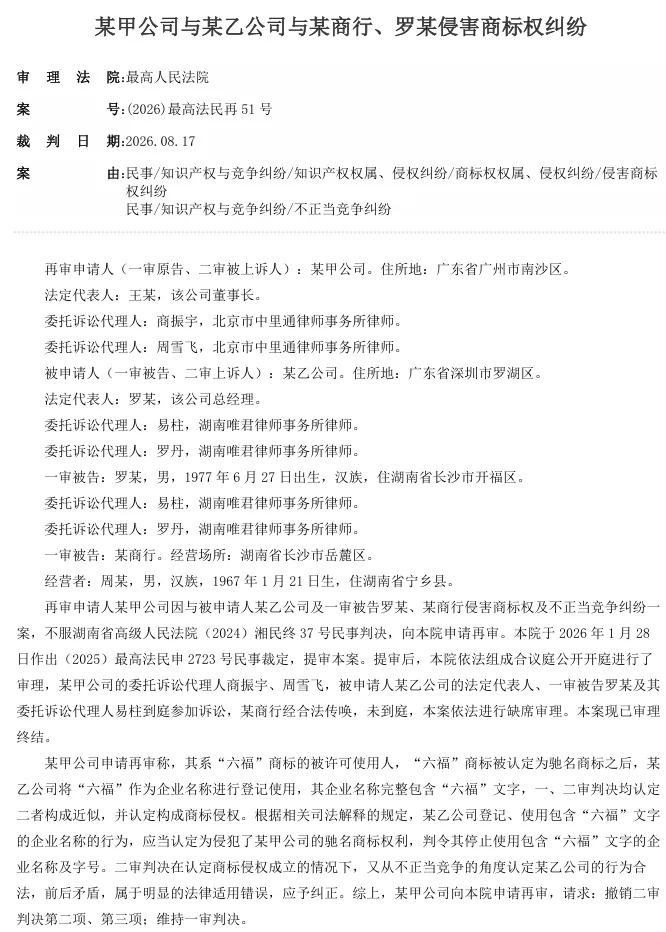
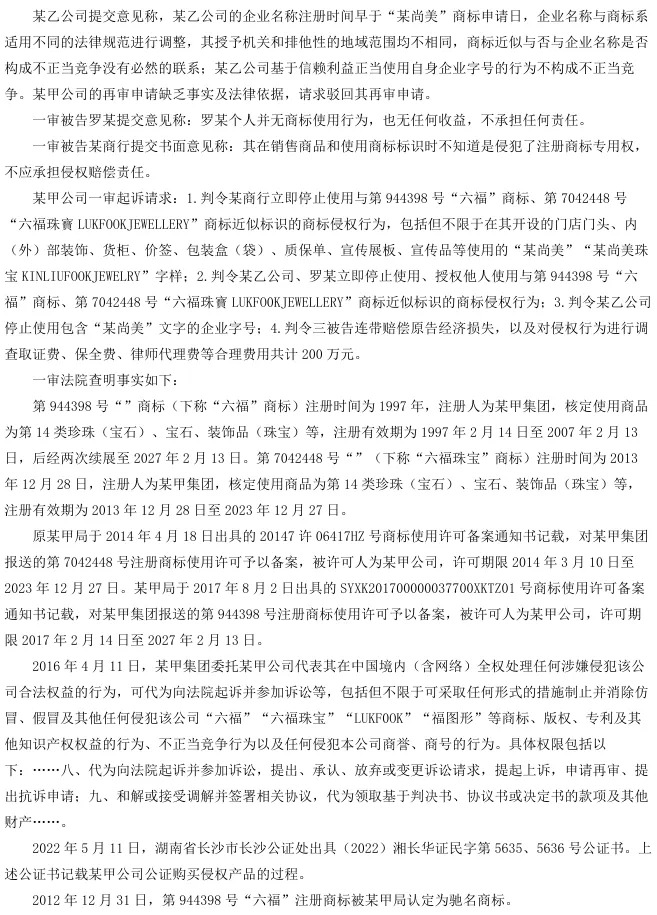
The "Liufu" trademark is a registered trademark of Company A, registered for use on goods such as jewelry in Class 14, and was recognized as a well-known trademark in 2012.
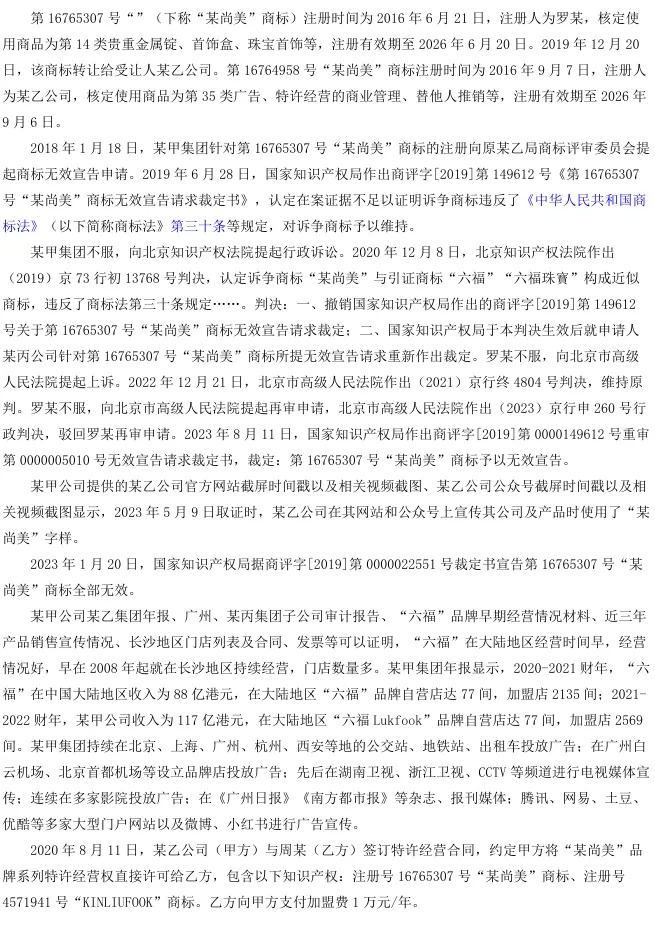
In 2016, Luo filed an application to register the "Jinliufu XX" trademark, designated for use on goods such as jewelry in Class 14, which was later assigned to Company B.
In 2018, Group A filed an invalidation request against the "Jinliufu XX" trademark; in 2023, the "Jinliufu XX" trademark was declared invalid.
In 2022, Company A filed a lawsuit against Company B for trademark infringement and unfair competition.
The First-Instance Court Held That:
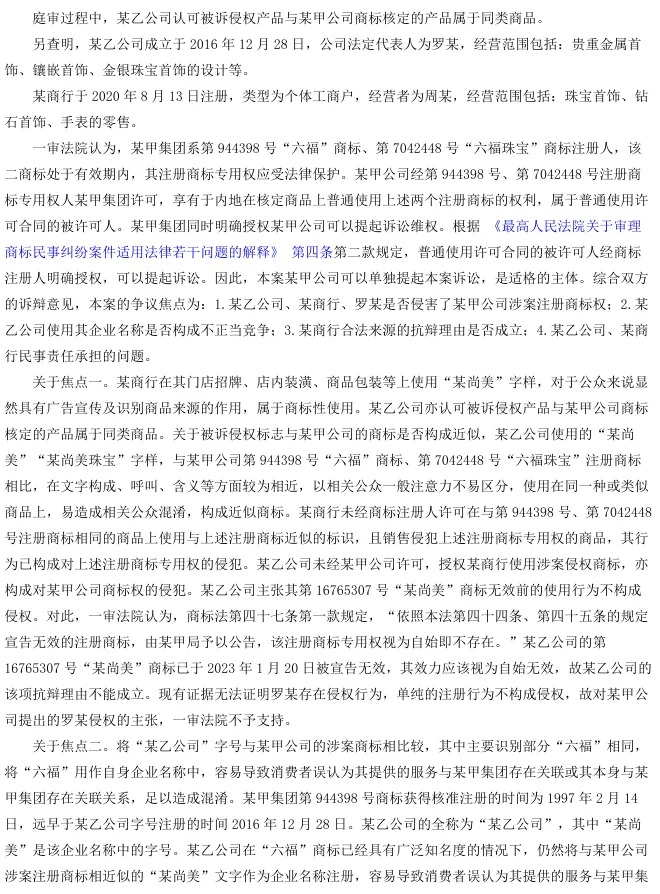
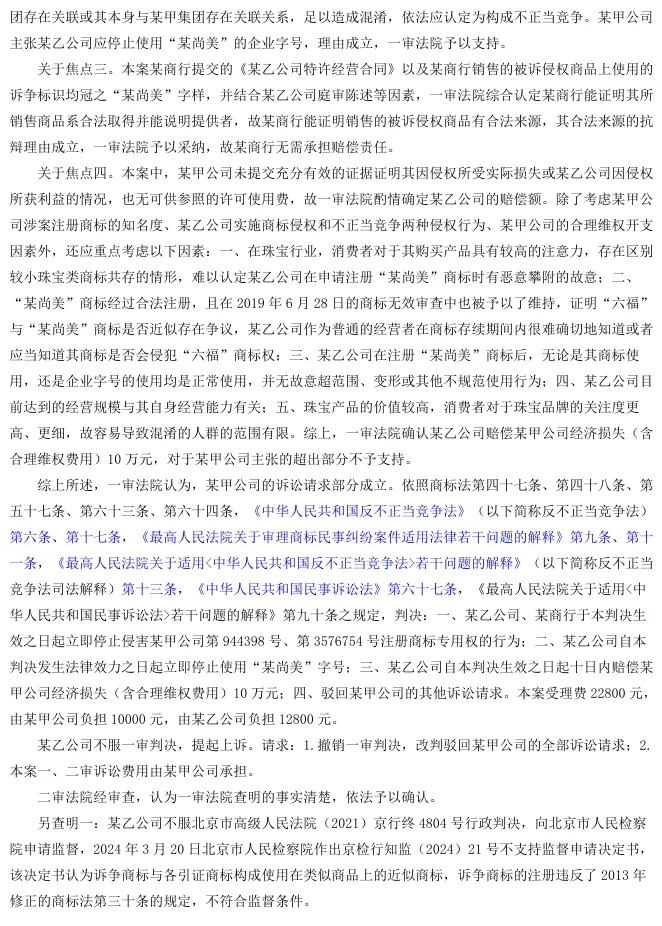
1.The use by Company B of the terms "Jinliufu XX" and "Jinliufu XX Jewelry" constituted similarity to Company A's "Liufu" trademark and "Liufu Jewelry" trademark, and its use on identical or similar goods constituted infringement of Company A's trademark rights.
2.Given that the "Liufu" trademark had acquired widespread recognition, Company B's registration of the similar term "Jinliufu XX" as part of its enterprise name was likely to cause consumers to mistakenly believe that the services it provided were associated with Group A or that Company B itself was associated with Group A, sufficient to cause confusion, and thus constituted unfair competition.
3.Company B was ordered to compensate Company A for economic losses (including reasonable enforcement costs) of RMB 100,000.
Company B was dissatisfied with the first-instance judgment and filed an appeal.
The Second-Instance Court Held That:
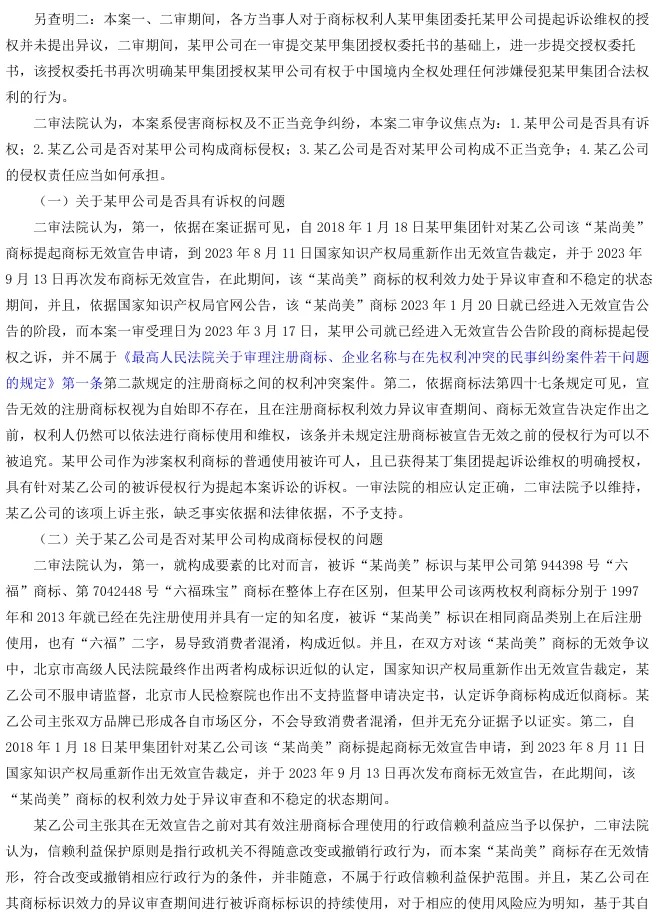
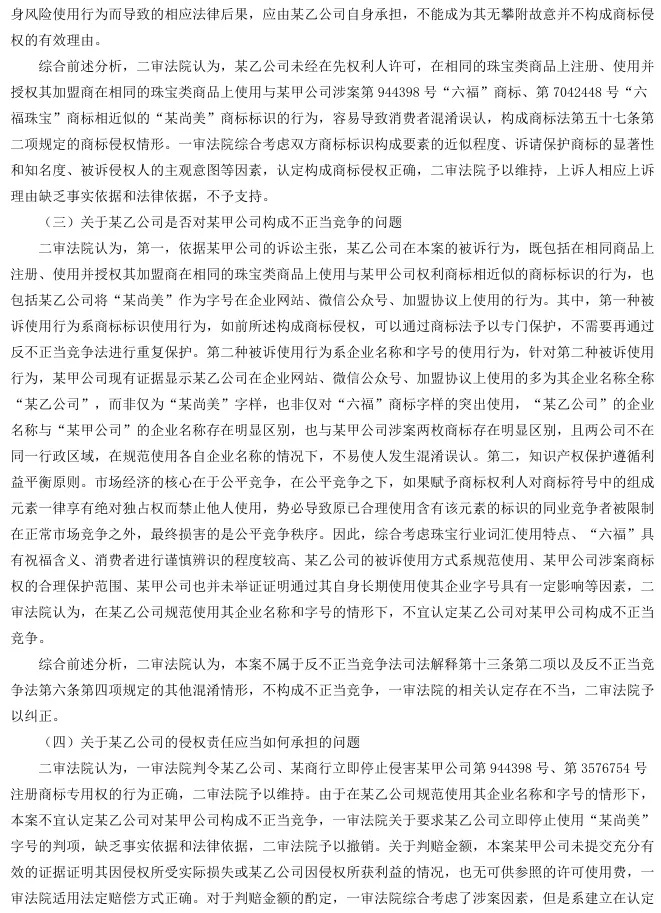
1.Company B, without the authorization of the prior rights holder, registered, used, and authorized its franchisees to use on identical jewelry goods the "Jinliufu XX" trademark identifier similar to Company A's "Liufu" trademark and "Liufu Jewelry" trademark, which was likely to cause consumer confusion and misunderstanding, constituting trademark infringement.
2.The evidence showed that Company B used its full enterprise name and did not make prominent use of the "Liufu" trademark characters. There were clear differences between Company B's enterprise name and Company A's enterprise name. Company A had not proven that its enterprise name (trade name) had acquired a certain influence, and the two companies were not located in the same administrative region. When enterprise names are used in a standard manner, confusion and misunderstanding are unlikely to occur. Therefore, Company B did not constitute unfair competition against Company A.
3.Company B was ordered to compensate Company A for economic losses (including reasonable enforcement costs) of RMB 50,000.
Company A was dissatisfied with the second-instance judgment and filed a retrial application.
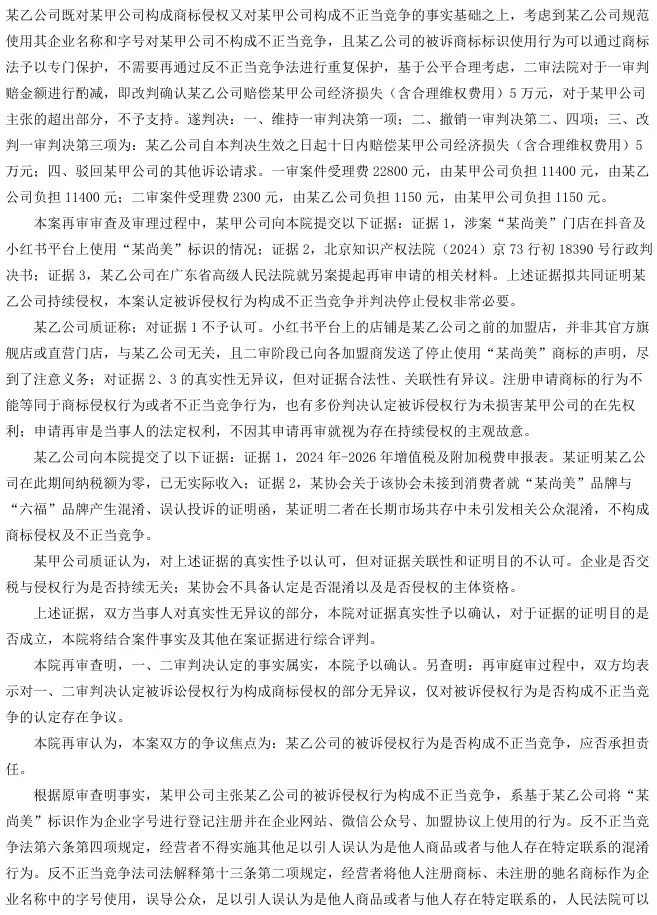
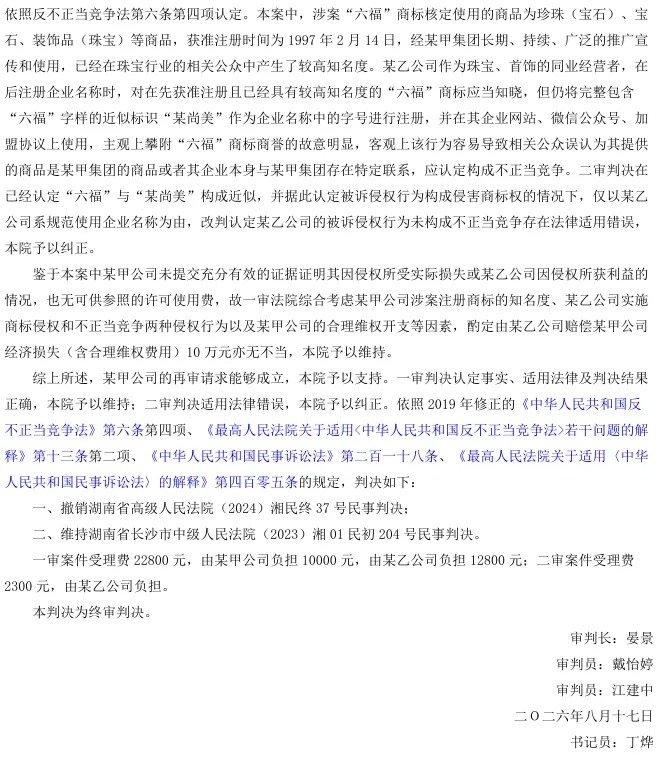
The Retrial Court Held That: The disputed issue between the parties in this case was whether the accused infringing acts of Company B constituted unfair competition and whether it should bear liability.
According to Article 13, Paragraph 2 of the Judicial Interpretation on the Anti-Unfair Competition Law, where a business operator uses another party's registered trademark or unregistered well-known trademark as a trade name in its enterprise name, misleading the public and sufficient to cause others to mistake it for another's goods or to believe there is a specific connection with another, the people's court may determine this under Article 6, Paragraph 4 of the Anti-Unfair Competition Law.
In this case, the "Liufu" trademark at issue, through Group A's long-term, continuous, and extensive promotion, publicity, and use, had acquired a high degree of recognition among the relevant public in the jewelry industry. Company B, as a competitor in the same industry, should have been aware of the highly recognized "Liufu" trademark when it subsequently registered its enterprise name, yet it still registered the similar identifier "Jinliufu XX" as a trade name in its enterprise name and used it on its corporate website, WeChat official account, and franchise agreements. Its subjective intent to free-ride on the goodwill of the "Liufu" trademark was evident, and objectively such conduct was likely to cause the relevant public to mistakenly believe that the goods it provided were Group A's goods or that its enterprise itself had a specific connection with Group A, constituting unfair competition. Company B was ordered to compensate Company A for economic losses (including reasonable enforcement costs) of RMB 100,000.
Conclusion
In this case, there was no dispute regarding the finding of trademark infringement across the first-instance, second-instance, and retrial proceedings.
As to whether unfair competition was constituted, the second-instance court disagreed with the first-instance court and the retrial court. Ultimately, however, the retrial court found that Company B's conduct constituted the circumstances stipulated in Article 6, Paragraph 4 of the Anti-Unfair Competition Law of the People's Republic of China.
Article 6 of the Anti-Unfair Competition Law of the People's Republic of China provides that a business operator shall not commit the following acts of confusion, causing others to mistake its goods for another's goods or to believe there is a specific connection with another:
1.Unauthorized use of an identifier identical or similar to another's commodity name, packaging, decoration, etc., that has a certain influence;
2.Unauthorized use of another's enterprise name (including abbreviation, trade name, etc.) that has a certain influence, the name of a social organization (including its abbreviation, etc.), or a person's name (including pen name, stage name, translated name, etc.);
3.Unauthorized use of the main part of another's domain name, website name, webpage, etc., that has a certain influence;
4.Other acts of confusion sufficient to cause others to mistake it for another's goods or to believe there is a specific connection with another.
The text of the final judgment is provided below for reference: